opening Christmas season
Christmas Poverty
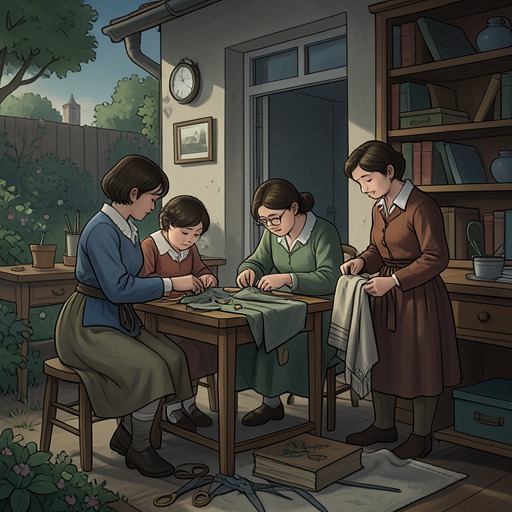
The four March sisters lament their poverty and their father’s absence at war, yet [Mrs. March](entity:character-recall-character-mrs-march-643f2e829fdb)’s example turns their frustration toward duty and mutual love. Each identifies a personal burden—vanity, temper, shyness, or discontent—and agrees to undertake the pilgrim journey of self-improvement.
Their childhood game of [The Pilgrim's Progress](entity:object-recall-object-the-pilgrim-s-progress-3662c44500d8) becomes a moral framework for the novel. The sisters begin to understand work, sacrifice, and self-command as the road toward the [Celestial City](entity:location-recall-location-celestial-city-f0fa6021c2c4), while the family’s affection remains their chief protection against hardship.
Christmas morning
The Christmas Breakfast Sacrifice
[The March sisters give up their Christmas breakfast](entity:action-recall-action-the-march-sisters-give-047ffbfed00c) after [Mrs. March](entity:character-recall-character-mrs-march-643f2e829fdb) tells them about the hungry Hummel family. They carry their food to the freezing household, where their simple generosity brings warmth, nourishment, and hope.
The girls return home hungry but unusually joyful, discovering that charity has transformed their own [Christmas](entity:time-recall-time-christmas-a573265d0167). Their sacrifice establishes the family’s ethic of service and links personal happiness with attention to others’ suffering.
Christmas evening
The Laurence Christmas Feast
After hearing of the sisters’ generosity, [James Laurence](entity:character-recall-character-james-laurence-bb583e81060d) sends an elaborate supper and flowers to the March family. The gift introduces the neighboring Laurence household as a source of unexpected kindness rather than merely intimidating wealth.
Jo becomes fascinated by [Theodore Laurence](entity:character-recall-character-theodore-laurence-17bc5ab43dc1), the lonely boy next door, and imagines that friendship may draw him out of isolation. The two families begin moving toward a lasting neighborly bond.
New Year's Eve
Jo Meets Laurie
At the Gardiners’ party, [Josephine March](entity:character-recall-character-josephine-march-fb100e7348b4) retreats from the dancing and unexpectedly meets [Theodore Laurence](entity:character-recall-character-theodore-laurence-17bc5ab43dc1) behind a curtain. Their shared shyness quickly gives way to candid conversation about names, travel, school, music, and the discomforts of social convention.
Laurie protects Jo from embarrassment over her scorched dress by dancing with her privately in the hall. Their immediate friendship becomes one of the novel’s central emotional relationships, founded on frankness, humor, and mutual recognition.
early winter
Jo Visits the Laurence Mansion
After seeing Laurie isolated at an upstairs window, [Josephine March](entity:character-recall-character-josephine-march-fb100e7348b4) invites herself across the hedge to cheer him. She brings food, Beth’s cats, and the lively companionship he lacks, then meets [James Laurence](entity:character-recall-character-james-laurence-bb583e81060d) and wins his respect through her blunt honesty.
The visit opens the [Laurence mansion](entity:location-recall-location-laurence-mansion-53e1d31a1f57) to the March sisters. James Laurence recognizes that the girls’ affection is restoring Laurie’s spirits, while Jo discovers the family’s library, conservatory, and grand piano as a new world of friendship and beauty.
several weeks later
Beth Receives the Piano
[Elizabeth March](entity:character-recall-character-elizabeth-march-1fe16a24e679) overcomes her fear of [James Laurence](entity:character-recall-character-james-laurence-bb583e81060d) and begins secretly practicing on his grand piano. Her gratitude inspires her to make him embroidered slippers, and James Laurence responds by giving her the piano that once belonged to his deceased granddaughter.
The gift deepens the emotional bond between Beth and James Laurence. Beth’s quiet gratitude also teaches the family that affection and selfless kindness can cross differences of age, wealth, and temperament.
later winter
Amy’s Pickled-Lime Punishment
[Amy Curtis March](entity:character-recall-character-amy-curtis-march-c5e5ec80ac35) brings contraband pickled limes to school to repay her classmates’ social debts. [Professor Davis](entity:character-recall-character-professor-davis-a84621b055cd) confiscates them, makes her throw them out, strikes her hand, and forces her to stand publicly on the platform.
Amy is humiliated, but [Mrs. March](entity:character-recall-character-mrs-march-643f2e829fdb) refuses to excuse the disobedience. The incident begins to expose Amy’s vanity and teaches her that genuine accomplishment requires modesty rather than display.
after Amy leaves school
Amy Burns Jo’s Manuscript
Angered that she cannot join [Josephine March](entity:character-recall-character-josephine-march-fb100e7348b4) and Laurie at the theater, Amy burns Jo’s cherished manuscript in retaliation. Jo responds with uncontrolled fury, shaking and striking her younger sister before withdrawing in grief.
The quarrel becomes a decisive test of Jo’s temper. When Amy later falls through thin ice, Jo recognizes that her refusal to forgive could have cost her sister’s life, and the family’s central struggle with self-conquest becomes painfully immediate.
the next day
Amy Falls Through the Ice
Amy follows [Josephine March](entity:character-recall-character-josephine-march-fb100e7348b4) and [Theodore Laurence](entity:character-recall-character-theodore-laurence-17bc5ab43dc1) to the river, despite their earlier quarrel. Ignoring Laurie’s warning, she skates toward unsafe ice and plunges into the water.
Jo and Laurie rescue her together. The danger breaks Jo’s anger, and [Mrs. March](entity:character-recall-character-mrs-march-643f2e829fdb) explains that temper is her daughter’s “bosom enemy,” requiring lifelong watchfulness, prayer, and patient effort.
spring
Meg’s Vanity Fair
[Margaret March](entity:character-recall-character-margaret-march-482af43addb7) visits [Annie Moffat](entity:character-recall-character-annie-moffat-4de7b23fe7a8) and enters a fashionable social world of fine clothes, parties, and luxury. She envies the Moffats’ wealth, accepts a makeover, and briefly enjoys being treated as a fashionable young lady.
Gossip about Laurie and the March family’s supposed matrimonial ambitions shocks Meg into recognizing the vulgarity beneath fashionable society. She returns home determined to value modesty, useful work, and the moral guidance of her parents over social glitter.
late spring
The Pickwick Club Opens Its Post Office
The sisters revive their [Pickwick Club](entity:organization-recall-organization-pickwick-club-c1d9b65c3f66) and admit [Theodore Laurence](entity:character-recall-character-theodore-laurence-17bc5ab43dc1) as an honorary member. Laurie surprises them from a closet, gives a comic speech, and establishes a post office in the hedge between the two homes.
The club and its post office create a shared imaginative world where letters, jokes, gifts, and secrets circulate. Their play anticipates the adult relationships that will later pass through the same household network.
early summer
The Failed Workless Experiment
The sisters agree to spend a week in leisure without their ordinary duties. Instead of producing happiness, idleness leaves the house untidy, tempers unstable, and each girl restless or dissatisfied.
When [Mrs. March](entity:character-recall-character-mrs-march-643f2e829fdb) withdraws and Hannah takes a holiday, the girls must manage the household themselves. Their disastrous meals and neglected responsibilities teach them that work gives structure, health, independence, and meaning to leisure.
July
Camp Laurence
The March sisters join [Theodore Laurence](entity:character-recall-character-theodore-laurence-17bc5ab43dc1) and his English friends at [Camp Laurence](entity:location-recall-location-camp-laurence-3148637867fa) on [Longmeadow](entity:location-recall-location-longmeadow-b43cecd2b1a3). The day includes boating, croquet, outdoor cooking, games, and improvised storytelling, while the young people test their manners and tempers in a freer social setting.
[Josephine March](entity:character-recall-character-josephine-march-fb100e7348b4) restrains herself after [Fred Vaughn](entity:character-recall-character-fred-vaughn-c013d925c13c) cheats at croquet, and [Elizabeth March](entity:character-recall-character-elizabeth-march-1fe16a24e679) bravely converses with the lame [Frank Vaughn](entity:character-recall-character-frank-vaughn-263d328c00fc). The excursion marks the sisters’ growing confidence and Laurie’s increasingly important place within the family.
late summer
The Castle-in-the-Air Dreams
On [Delectable Mountain](entity:location-recall-location-delectable-mountain-12c6bb646e91), the sisters and Laurie describe the futures they imagine. Laurie dreams of music in [Germany](entity:location-recall-location-germany-2e3723c2f347), Meg of luxury and a beautiful home, Jo of literary fame, Beth of family, and Amy of artistic greatness in [Rome](entity:location-recall-location-rome-3ec0a741c1f4).
Their dreams reveal both their aspirations and their vulnerabilities. The conversation establishes the promises and tensions that will shape the rest of the novel, especially the contrast between youthful fantasy and mature vocation.
late autumn
Jo’s First Publication
[Josephine March](entity:character-recall-character-josephine-march-fb100e7348b4) secretly submits stories to a newspaper and later discovers that “The Rival Painters” has been printed. Her family celebrates the achievement, though the payment is only the promise of future recognition.
Publication gives Jo proof that writing may become a livelihood and a means of supporting those she loves. It also intensifies her ambition to achieve independence through literature.
November
The Telegram About Mr. March
A telegram arrives at the [March family home](entity:location-recall-location-march-family-home-e2aeace7c126) announcing that [Mr. March](entity:character-recall-character-mr-march-d8dbad315824) is gravely ill in [Washington](entity:location-recall-location-washington-e333281d93a5). [Mrs. March](entity:character-recall-character-mrs-march-643f2e829fdb) immediately prepares to travel, while the sisters and their friends mobilize to provide money, supplies, and protection.
The crisis turns domestic ideals into urgent action. [John Brooke](entity:character-recall-character-john-brooke-31ffe7f1b46c) offers to escort Mrs. March, [James Laurence](entity:character-recall-character-james-laurence-bb583e81060d) provides financial help, and the family’s network of affection becomes their practical means of survival.
the same day
Jo Sells Her Hair
Desperate to help pay for her mother’s journey and her father’s care, [Josephine March](entity:character-recall-character-josephine-march-fb100e7348b4) sells her long hair for twenty-five dollars. She initially jokes about the sacrifice, but later cries privately over the loss of her one cherished beauty.
The act marks a decisive movement from girlhood vanity toward adult self-denial. Jo’s love is expressed not through grand speeches but through surrendering something personally precious for her family.
the following morning
Mrs. March Travels to Washington
[Mrs. March](entity:character-recall-character-mrs-march-643f2e829fdb) leaves for [Washington](entity:location-recall-location-washington-e333281d93a5) with [John Brooke](entity:character-recall-character-john-brooke-31ffe7f1b46c) as escort, entrusting the girls to [Hannah Mullet](entity:character-recall-character-hannah-mullet-ccae6d201b14) and [James Laurence](entity:character-recall-character-james-laurence-bb583e81060d). The sisters promise to continue their work and comfort one another rather than collapse into idleness or despair.
The departure separates the household from its emotional center and tests whether the girls can practice the virtues their mother has taught them. Their letters from home become a record of effort, anxiety, and hope.
about ten days later
Beth Contracts Scarlet Fever
[Elizabeth March](entity:character-recall-character-elizabeth-march-1fe16a24e679) continues visiting the Hummel family after the baby’s illness and death. She contracts scarlet fever, while Hannah and Jo initially underestimate the seriousness of her condition.
Amy is sent away to [Aunt March](entity:character-recall-character-aunt-march-e17fc2e97b33)’s house to avoid infection, and Jo remains at home to nurse Beth. The family’s earlier neglect of the Hummels returns as a source of guilt, while Beth’s selfless service becomes the cause of her own danger.
early December
Beth’s Scarlet Fever Crisis
Beth’s fever worsens: she becomes delirious, calls for her mother, and loses awareness of the people around her. [Mr. March](entity:character-recall-character-mr-march-d8dbad315824) suffers a relapse in [Washington](entity:location-recall-location-washington-e333281d93a5), leaving the family afraid that both parents may be absent during the crisis.
When the doctor warns that [Mrs. March](entity:character-recall-character-mrs-march-643f2e829fdb) must be summoned, [Josephine March](entity:character-recall-character-josephine-march-fb100e7348b4) sends the telegram despite Hannah’s reluctance. [Theodore Laurence](entity:character-recall-character-theodore-laurence-17bc5ab43dc1) supports Jo emotionally, while the household waits through a night of terrible uncertainty.
the following night
Beth Survives the Fever
After hours of watching, Beth’s fever breaks shortly after midnight. Her breathing becomes natural and the doctor confirms that she will survive, though she remains weak.
[Mrs. March](entity:character-recall-character-mrs-march-643f2e829fdb) arrives from [Washington](entity:location-recall-location-washington-e333281d93a5) soon afterward, bringing the emotional relief the family has been waiting for. The crisis deepens the sisters’ understanding of Beth’s importance and strengthens their gratitude for one another.
during Beth’s illness
Amy’s Will
At [Aunt March](entity:character-recall-character-aunt-march-e17fc2e97b33)’s house, [Amy Curtis March](entity:character-recall-character-amy-curtis-march-c5e5ec80ac35) confronts her fear of illness and separation. Guided partly by Esther, she creates a private chapel and writes a childish will distributing her possessions among her family and friends.
The exercise reveals that Amy’s vanity is being transformed by love and fear of loss. She gives particular attention to Beth, regrets her past selfishness, and begins deliberately aspiring to Beth’s selflessness.
three years after the opening
Meg Marries John Brooke
After [John Brooke](entity:character-recall-character-john-brooke-31ffe7f1b46c) recovers from a war wound and establishes himself as a bookkeeper, [Margaret March](entity:character-recall-character-margaret-march-482af43addb7) marries him in a modest ceremony. She chooses a homemade gown, lilies of the valley, and the presence of family over fashionable display.
The marriage confirms [Mrs. March](entity:character-recall-character-mrs-march-643f2e829fdb)’s belief that love and character matter more than wealth. Meg leaves the [March family home](entity:location-recall-location-march-family-home-e2aeace7c126) for the [Dovecote](entity:location-recall-location-dovecote-9fdc3648d81f), but the sisters’ affection remains intact.
after Meg’s marriage
Jo Wins the Story Prize
[Josephine March](entity:character-recall-character-josephine-march-fb100e7348b4) submits a sensational story to a newspaper competition and wins a hundred-dollar prize. She uses the money to send Beth and [Mrs. March](entity:character-recall-character-mrs-march-643f2e829fdb) to the seaside, where Beth’s health improves somewhat.
The success shows Jo that writing can materially support her family. It also begins her more serious confrontation with the difference between popular success and the kind of literature she truly wants to create.
early married life
Meg’s Domestic Quarrel
Meg’s attempt to make currant jelly fails, and [John Brooke](entity:character-recall-character-john-brooke-31ffe7f1b46c) unexpectedly brings a friend home to dinner. Exhausted and humiliated by the disorder, Meg lashes out and refuses to receive the guest, while John feels abandoned and embarrassed.
The couple eventually reconcile when Meg overcomes her pride and asks forgiveness. Their “family jar” becomes a comic emblem of marriage: domestic happiness depends less on perfection than on patience, candor, and mutual forgiveness.
later in the first year of marriage
Meg Learns Domestic Partnership
After the birth of Daisy and Demi, Meg becomes so absorbed in motherhood that she neglects John and allows the children to dominate the household. John begins spending evenings with the Scotts, leaving Meg lonely and resentful.
[Mrs. March](entity:character-recall-character-mrs-march-643f2e829fdb) explains that marriage requires shared work and shared interests: John must participate in the nursery, while Meg must preserve time for her husband, exercise, and the wider world. The couple reforms its household through division of labor and renewed companionship.
after Meg’s marriage
Amy Travels to Europe
[Amy Curtis March](entity:character-recall-character-amy-curtis-march-c5e5ec80ac35) travels to Europe with [Aunt Carrol](entity:character-recall-character-aunt-carrol-087578387115) and Flo, visiting [London](entity:location-recall-location-london-420923d4a60a), [Paris](entity:location-recall-location-paris-c02b439ce220), [Germany](entity:location-recall-location-germany-2e3723c2f347), and Switzerland. She studies paintings, museums, landscapes, languages, and social customs while corresponding with her family.
Her foreign experience matures her artistic ambitions and social confidence. She also begins considering marriage to the wealthy [Fred Vaughn](entity:character-recall-character-fred-vaughn-c013d925c13c), believing that security and position may be the wisest route for one March sister.
Heidelberg
Amy Rejects Fred Vaughn
In [Heidelberg](entity:location-recall-location-heidelberg-fef686c04437), [Amy Curtis March](entity:character-recall-character-amy-curtis-march-c5e5ec80ac35) recognizes that [Fred Vaughn](entity:character-recall-character-fred-vaughn-c013d925c13c)’s wealth and manners do not awaken the love she expected. When he eventually proposes, she declines despite the comfortable future he could provide.
The decision marks Amy’s rejection of a marriage based chiefly on money and status. Her values have shifted from social ambition toward emotional truth, though she has not yet understood where her deeper affection lies.
after Jo returns from New York
Beth Reveals Her Death
[Josephine March](entity:character-recall-character-josephine-march-fb100e7348b4) returns from [New York](entity:location-recall-location-new-york-f84f7f10ee10) and sees that [Elizabeth March](entity:character-recall-character-elizabeth-march-1fe16a24e679) is visibly declining. At the seaside, Beth finally tells Jo that she believes she will not live long and that she has already accepted the approaching separation.
Beth explains that she never imagined a future of marriage or worldly achievement, only a life of usefulness at home. Jo rejects the diagnosis at first, but Beth asks her to prepare their parents and to stand by them after her death.
soon after Laurie’s graduation
Jo Rejects Laurie’s Proposal
Laurie confesses that he has loved [Josephine March](entity:character-recall-character-josephine-march-fb100e7348b4) for years and asks her to marry him. Jo answers honestly that she loves him as a brother but cannot return his romantic feelings, and she refuses to build a marriage on gratitude or pressure.
The rejection breaks Laurie’s boyish romantic illusion and forces both of them to accept that deep friendship does not necessarily become marriage. Laurie leaves for Europe with [James Laurence](entity:character-recall-character-james-laurence-bb583e81060d), while Jo remains haunted by the pain she has caused.
the following spring
Beth’s Death
[Elizabeth March](entity:character-recall-character-elizabeth-march-1fe16a24e679)’s health steadily fails, though her family creates a loving room around her and tries to make her final year peaceful. She gives away small gifts, blesses the household with patience, and teaches Jo that love and service matter more than ambition.
Beth dies quietly before dawn, held within the home where she was born. Her death devastates the family but also transforms Jo’s understanding of vocation: she resolves to live for her parents and to turn grief into a more generous life.
after Beth’s death
Laurie and Amy Reconcile
Laurie, having abandoned his idle European life, meets Amy in [Vevay](entity:location-recall-location-vevay-3d9c9bf5c8a9) while she is grieving abroad. Amy recognizes the pain beneath his laziness and tells him that wasting his gifts is selfish and unworthy of the people who love him.
Her blunt counsel reawakens Laurie’s sense of purpose. Their friendship deepens into mutual love as they row together on [Lake Geneva](entity:location-recall-location-lake-geneva-7be17872d06b), and Laurie asks Amy to share his life; she accepts.
several weeks after their engagement
Laurie and Amy Marry
[Laurie and Amy marry](entity:action-recall-action-laurie-and-amy-marry-90b17d2e5893) quietly in [Paris](entity:location-recall-location-paris-c02b439ce220) while traveling with the Carrol family. They then spend their honeymoon at [Valrosa](entity:location-recall-location-valrosa-9e2add3decfe), where the marriage becomes both a romantic union and a partnership founded on mutual respect.
Their return reveals Amy as a mature gentlewoman and Laurie as a purposeful man preparing to enter business. Their relationship fulfills the emotional possibility that Jo had once imagined for Laurie, but only after both have grown beyond youthful fantasy.
Jo’s twenty-fifth birthday
Jo Meets Friedrich Bhaer Again
[Friedrich Bhaer](entity:character-recall-character-friedrich-bhaer-7b4a913ca571) arrives unexpectedly at the [March family home](entity:location-recall-location-march-family-home-e2aeace7c126) after Jo has returned from [New York](entity:location-recall-location-new-york-f84f7f10ee10). He is welcomed into the family, and his kindness, learning, and humility win everyone’s approval.
Jo’s joy at seeing him exposes feelings she has not previously admitted. Unlike her former ambition for fame and wealth, her affection for Bhaer grows from companionship, moral respect, and shared service.
soon after Bhaer’s return
Jo and Bhaer Become Engaged
Bhaer accompanies Jo through the rain while helping her buy gifts for children and a shawl for a poor mother. When Jo believes he is leaving, she weeps and admits that his absence pains her.
Bhaer declares his love and asks whether she can make room for him in her heart. Jo accepts beneath the umbrella, choosing a life of shared labor, poverty, education, and affection over independence pursued in isolation.
the following year
Jo Inherits Plumfield
[Aunt March](entity:character-recall-character-aunt-march-e17fc2e97b33) dies and leaves [Plumfield](entity:location-recall-location-plumfield-ef88c8b9f8b1) to [Josephine March](entity:character-recall-character-josephine-march-fb100e7348b4). Rather than sell the estate, Jo decides to turn it into a home and school for boys who need education, kindness, and maternal care.
The inheritance converts Jo’s long-standing dream of usefulness into a concrete vocation. With [Friedrich Bhaer](entity:character-recall-character-friedrich-bhaer-7b4a913ca571) teaching and Jo caring for the pupils, Plumfield becomes the setting in which her restless energy finds its most lasting purpose.
several years later
Plumfield School Flourishes
Jo and [Friedrich Bhaer](entity:character-recall-character-friedrich-bhaer-7b4a913ca571) establish [Plumfield School](entity:organization-recall-organization-plumfield-school-ec55aa9d2f1f), a lively homelike community for rich and poor boys. The pupils work in the grounds, keep animals, study, play, and receive the patient discipline of the Bhaers.
Jo becomes “Mother Bhaer,” discovering that the boys’ affection gives her deeper satisfaction than literary fame. Her school embodies the novel’s belief that neglected children can be redirected by love, work, and confidence in their latent goodness.
five years after Jo’s marriage
The March Family’s Harvest
At [Plumfield](entity:location-recall-location-plumfield-ef88c8b9f8b1)’s annual apple-picking festival, the Marches, Laurences, Brookes, and Bhaers gather with their children and pupils. The family’s separate homes have become a larger community joined by affection, work, memory, and shared responsibility.
Each woman reflects on her former castle in the air and recognizes that her actual life, though different from youthful fantasy, contains a richer harvest. [Mrs. March](entity:character-recall-character-mrs-march-643f2e829fdb) blesses her daughters, declaring that she cannot wish them greater happiness than the love and usefulness they have achieved.